

The differential pressure alarm hasn’t tripped. But something’s off — the governing valve is a beat slower than it used to be, or it hesitates slightly before settling into position. No alarm, no clear fault code, just a feeling that response isn’t quite what it was six months ago. This is exactly the gray zone where a lot of turbine maintenance teams get stuck, and it usually comes down to one of two suspects: the HC9600FRP8Z filter letting particles through before it’s technically due for a change, or a servo valve that’s quietly wearing out.
Both problems can produce similar symptoms on the surface. Both deserve a real answer before you start swapping parts based on a guess.
Why This Filter Exists in the First Place
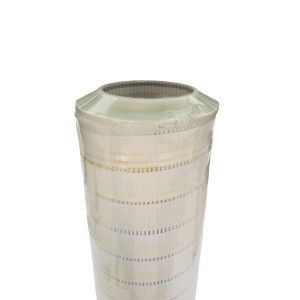
Governing oil systems on a steam turbine run at tolerances that don’t forgive contamination the way a lot of other hydraulic circuits might. The HC9600FRP8Z filter element uses Supralon media rated for a Beta ratio of 2000 or greater at 5 microns — in plain terms, for every 2000 particles of 5 microns or larger entering the filter, only one is expected to pass through on the clean side. That’s a genuinely high standard, built specifically for circuits feeding servo valves and other tight-tolerance components downstream.
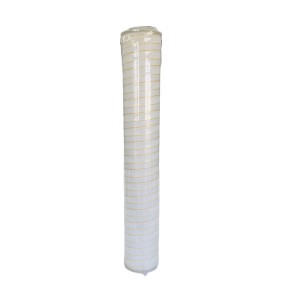
This level of filtration matters because servo valves and governing system components operate with internal clearances measured in microns. Particles that would be irrelevant in a coarser hydraulic system can lodge in those clearances here, and the consequences show up as exactly the kind of response degradation this article is about.
Two Different Failure Paths, Similar Surface Symptoms
Here’s the core problem with diagnosing sluggish response by feel alone: a filter that’s starting to let fine particles bleed through, and a servo valve that’s developing internal wear, can both produce a governing system that responds a little slower or a little less precisely than it should. Neither one necessarily trips a differential pressure alarm right away.
Filter bleed-through happens gradually as the filter media approaches its capacity — not a sudden failure, but a slow decline in filtration efficiency as the media loads up, sometimes allowing progressively finer particles through even before the differential pressure climbs enough to trigger an alarm. Servo valve wear, on the other hand, is a mechanical degradation of the valve’s own internal surfaces — spool, sleeve, nozzle, flapper, depending on design — accumulating from years of cycling and any contamination exposure over that service life.
Looking at Governing Oil Pressure Fluctuation
This is one of the more useful early indicators, and it behaves somewhat differently depending on which problem you’re actually facing.
What Filter-Related Bleed-Through Tends to Look Like
When fine particles are getting through the filter media and starting to interfere with servo valve internals, you often see a pattern of gradually increasing pressure fluctuation — small, somewhat random variations in governing oil pressure that weren’t as pronounced previously. This happens because migrating fine particles can partially and intermittently obstruct small orifices or throttling passages inside the servo valve, creating momentary flow disturbances that show up as pressure noise rather than a clean, steady signal.
Notably, this kind of fluctuation tends to correlate loosely with overall system contamination trends — if you pull an oil sample during a period of noticeable pressure noise, particle counts are often elevated compared to a baseline sample, even if differential pressure across the filter itself hasn’t yet crossed into alarm territory.
What Servo Valve Wear Tends to Look Like
Mechanical wear inside the servo valve tends to produce a different pressure signature — less about random noise and more about a gradual shift in the baseline relationship between control signal and resulting oil pressure. As internal clearances open up from wear, the valve may require a slightly different signal input to achieve the same output pressure it used to reach with a smaller input, and that relationship tends to drift consistently rather than fluctuating randomly.
Wear-related pressure behavior is also generally more repeatable and predictable cycle to cycle, since it’s a fixed mechanical change rather than a contamination level that varies with oil sampling conditions. If you see a consistent, repeatable shift rather than random noise, wear is the more likely explanation.
| Symptom | Filter Bleed-Through Pattern | Servo Valve Wear Pattern |
|---|---|---|
| Pressure fluctuation | Random, noisy, correlates with contamination events | Consistent, repeatable shift in baseline behavior |
| Relationship to oil sampling | Elevated particle counts during fluctuation periods | Particle counts may remain normal |
| Progression pattern | Can appear and partially resolve as particles clear or worsen with continued loading | Steadily progresses, doesn’t self-resolve |
Looking at Actuator Response Time
Timing the actual movement of the governing actuator from command signal to achieved position gives a second, complementary data point, and again the two failure modes tend to show slightly different characteristics.
Filter-Related Response Changes
When particle bleed-through is interfering with servo valve internals, response time changes often show up as inconsistency — a response that’s normal on one cycle and noticeably slower on the next, without a clear, steady trend in either direction. This inconsistency reflects the somewhat random nature of particle interference, since exactly how much a given particle disrupts flow depends on where and when it happens to lodge.
Wear-Related Response Changes
Mechanical wear tends to produce a steadier, more gradual trend in response time — a slow, consistent lengthening over weeks or months rather than cycle-to-cycle inconsistency. This makes sense given the underlying cause: wear accumulates steadily with operating hours, so its effect on response time should trend steadily too, rather than jumping around unpredictably.
- Log actuator response time consistently over a period of weeks, not just a single spot check, to distinguish a genuine trend from normal day-to-day variation.
- Note whether response time variability is random (pointing toward filter bleed-through) or shows a steady directional trend (pointing toward servo valve wear).
- Cross-reference timing data against recent oil sample particle counts when available, since a spike in fine particulate coinciding with response inconsistency strengthens the case for filter-related causes.
A Practical Diagnostic Sequence
Rather than guessing, working through a short sequence of checks tends to point clearly toward one cause or the other in most cases.
- Pull an oil sample and get a particle count analysis, ideally comparing 5-micron and finer particle counts against your system’s established baseline — a meaningful increase supports the filter bleed-through explanation.
- Review differential pressure trend data across the HC9600FRP8Z filter over recent weeks, even if it hasn’t reached alarm level — a filter that’s climbing steadily toward its rated capacity is more likely to be bleeding fine particles even before the alarm point, compared to one sitting comfortably low.
- Log actuator response time and governing pressure fluctuation over a comparable period, characterizing the pattern as random/inconsistent versus steady/trending as described above.
- If particle counts and differential pressure both point toward a loading filter, and response symptoms show the random, inconsistent pattern associated with bleed-through, schedule a filter change before waiting for the alarm to trigger.
- If particle counts remain normal and differential pressure is comfortably low, but response time shows a steady, repeatable trend, focus attention on the servo valve itself — internal inspection or a planned rebuild is the more likely path forward.
Why Waiting for the Differential Pressure Alarm Isn’t Enough on Its Own
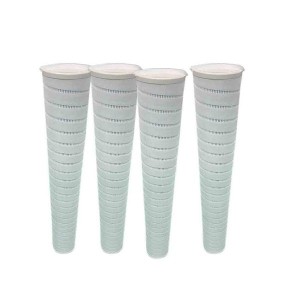
A Beta 2000-rated filter like the HC9600FRP8Z is a genuinely high-performance media, but Beta ratios describe steady-state filtration performance, not necessarily behavior right at the edge of the media’s service life. As any filter media approaches saturation, filtration efficiency for the finest particles it’s rated to catch can begin degrading before differential pressure has risen enough to cross an alarm threshold calibrated primarily around flow restriction rather than filtration quality specifically.
This is really the underlying reason the diagnostic approach above matters — differential pressure alone tells you about flow restriction, not necessarily about whether fine particles are still being caught as effectively as when the filter was new. Pairing pressure trend data with actual particle count sampling closes that gap.
What This Means for Maintenance Planning
Building a routine that pairs oil sampling with governing system performance trending, rather than relying solely on differential pressure alarms, gives maintenance teams a genuine head start on distinguishing these two failure modes. It also protects the more expensive component in this comparison — a servo valve is a considerably costlier fix than a filter element, and correctly attributing a response problem to filter bleed-through rather than assuming servo valve wear (or vice versa) avoids unnecessary component replacement based on an incorrect diagnosis.
If your plant is seeing governing response inconsistency without a triggered pressure alarm, it’s worth pulling recent particle count data and actuator timing logs together before deciding on a course of action — comparing the pattern against the characteristics described here often points clearly toward one cause over the other.
Final Thoughts
Sluggish or inconsistent governing valve response before any differential pressure alarm has triggered isn’t something to shrug off, but it also isn’t something to react to by guessing which component to replace first. The HC9600FRP8Z filter and the servo valve it protects can both produce similar surface symptoms, but the underlying patterns — random versus steady pressure fluctuation, inconsistent versus trending response time, elevated versus normal particle counts — genuinely do differ enough to point toward the right answer with a bit of careful data comparison.
Taking the time to log this data consistently, rather than reacting to a single off cycle, is what turns an ambiguous symptom into a clear diagnosis and a correctly targeted fix.
Post time: Sep-04-2026
-

High Energy Igniter Spark Rod XDZ-F-2990
-

BR110 air filter Compressed air impurity filtra...
-

EH oil system globe valve SHV20
-

Surface cover epoxy air-dry varnish 1504
-

EH Oil Main Pump Discharge Oil Filter Element D...
-

WZPM2-001 PT100 Platinum thermal resistance The...
-

LVDT sensor TDZ-1-50
-

YSF series pressure relief valve for transformer
-

Steam Turbine EH Oil System Servo Valve 072-559A
-

977HP sealing oil differential pressure valve
-

Actuator Inlet Working Oil Filter DP301EA10V/-W
-

RTD thermocouple temperature sensor probe WZP2-231