

3:15 in the morning, and a conductivity alarm trips on the stator cooling water panel. The 2401B-K electrode is reading higher than it should be. Somebody’s got to figure out, pretty fast, whether this is a real water quality issue heading somewhere bad, or just an electrode that needs a clean. And that decision doesn’t come with a lot of time to sit and think about it.
This isn’t something you get to mull over slowly. Stator cooling water conductivity is tied straight to insulation health inside the generator windings, and a real water quality problem doesn’t stay small for long if nobody deals with it.
Why This Electrode Sits Where It Does
The 2401B-K Conductivity Electrode keeps watch on the ionic content of stator cooling water — pure deionized water running through hollow conductors inside the windings, carrying heat away while the generator’s running. That water has to stay very low in conductivity, because any real rise means ions are showing up in it, and ions in that water mean a real risk of insulation damage or even localized electrical tracking inside the winding passages over time.
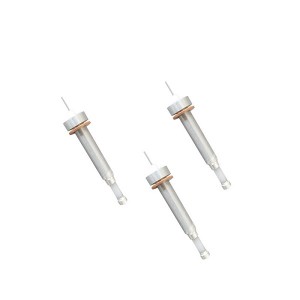
Given what’s at stake, this isn’t some nice-to-have gauge sitting on a panel somewhere. It’s one of the main early warnings protecting the generator’s cooling circuit, and when it climbs, it needs an answer now, not later.
Three Things It Could Actually Be
Once that alarm goes off, there’s really three possibilities, and each one needs a different response. Figuring out which one you’re dealing with is job one, before anything else happens.
1. The Electrode’s Fouled or Just Getting Old
Conductivity electrodes pick up deposits over time, even in a fairly clean system. A fouled surface throws off what the sensor’s actually measuring, and sometimes that shows up as a climbing reading even though the water itself hasn’t really gotten any worse.
Aging is its own thing too, separate from fouling — the sensing element drifts over months or years, slowly reading high even with no visible buildup on it. That’s exactly why calibration checks need to happen on a set schedule, not just whenever a number starts looking off.
2. The Resin’s Just Worn Out
Stator cooling water systems lean on ion exchange resin — usually a mixed-bed polisher — to keep pulling ions out and keep conductivity down. That resin only has so much capacity, and once it gets close to used up, it starts letting more through. Sometimes that’s gradual, sometimes it happens pretty fast once the bed hits a certain point.
This is honestly the most common explanation behind a real conductivity rise, and it’s also the easiest to deal with, assuming you catch it and confirm it quickly. Resin running out is expected maintenance, not usually a sign something deeper’s wrong.
3. Something’s Actually Contaminating the System
The scarier option is that something’s introducing contamination the resin bed just isn’t built to handle, or it’s getting overwhelmed by it. Could be a leak letting some other fluid in, corrosion products building up somewhere in the piping or heat exchanger, or a chemistry problem upstream in the makeup water.
This is the one that actually threatens the generator if it’s not caught and fixed fast, because it’s an ongoing source, not just a used-up resin bed you swap out and move on.
Figuring Out Which One You’re Dealing With
A quick, methodical check usually sorts this out in minutes — you don’t need a full lab report before making a decision.
- Check the electrode against a calibration or reference standard if you’ve got one on hand — comparing readings tells you almost right away whether the sensor’s actually accurate.
- Look at resin bed differential pressure and how much throughput it’s seen lately — if it’s approaching where you’d expect exhaustion based on flow history, that’s probably your answer.
- See if there’s a second, independent conductivity point somewhere else in the circuit — if only the 2401B-K spot is showing the rise while everything else looks normal, that points at something local, maybe the electrode, maybe a nearby contamination source specific to that section.
- Check recent maintenance work on the cooling water system — anything touching the piping, heat exchanger, or makeup water supply lately is worth flagging right away as a possible source.
- Grab a water sample for the lab while you’re doing all this — even if the field checks already point one way, lab confirmation gives you something solid before committing to a fix.
| Cause | What to Look For | What to Do |
|---|---|---|
| Electrode fouled or drifting | Field check against calibration standard doesn’t match | Clean or recalibrate, confirm the reading comes back down |
| Resin worn out | High throughput, differential pressure climbing toward limit | Replace or regenerate resin per standard procedure |
| Actual contamination | Reading still climbing despite good resin and a checked-out electrode, other red flags present | Dig into system integrity, isolate the source, loop in engineering |
How Much Time Do You Really Have?
This is really the question everyone actually wants answered once that alarm goes off, and it deserves a straight answer instead of a fuzzy one. Truth is, the window between an alarm and an actual threat to the generator isn’t some fixed number — it depends on how fast conductivity’s climbing, how far past the alarm point it gets, and how long it stays elevated before someone actually does something about it.
What we can say for sure: an alarm going off doesn’t mean the generator’s in immediate danger. That threshold’s set with margin built in on purpose, so operators actually have time to figure out what’s wrong and fix it before conductivity gets anywhere near the levels that actually risk the insulation. But that margin isn’t infinite — it shrinks the longer the real cause sits there unaddressed.
Why You Still Need to Move Fast Even With Margin There
That margin exists so you have a real shot at responding, not so you can put it off. If conductivity keeps climbing after the alarm — especially faster than your first look suggested — that margin’s getting eaten up the whole time. Treating the alarm like something you’ll “get to when there’s a minute” is exactly how a manageable problem turns into a real one.
- Start checking the moment the alarm goes off, not after you finish whatever else was on the list.
- Bring in engineering or a senior operator quickly if your first checks don’t clearly land on electrode fault or plain resin exhaustion.
- Keep watching the trend the whole time you’re diagnosing — if the number’s still climbing even after you’ve already swapped resin, that’s a pretty strong sign you haven’t found the real cause yet.
- Don’t just assume the resin change fixed things because the reading dropped back down — check the electrode too, during the same event, before you close the book on it.
What Good Practice Looks Like Before the Alarm Even Sounds
A lot of the stress during an actual alarm goes away if a few things are already sorted out ahead of time, instead of getting figured out on the fly under pressure.
- Keep a real calibration schedule for the 2401B-K and actually stick to it, so checking it during an alarm is fast and something you can trust, not a guessing game.
- Track resin bed throughput and differential pressure over time, so you see exhaustion coming instead of finding out only once conductivity’s already climbing.
- Have a clear, written escalation procedure just for conductivity alarms, so nobody’s making it up on the spot during a stressful 3am call.
- Check in on recent maintenance history for the cooling water system now and then, just as part of normal awareness, so a contamination source — if one shows up — isn’t a total surprise out of nowhere.
Why This Matters to Procurement and Reliability Teams Too
An electrode that drifts unpredictably or fouls faster than it should doesn’t just cause annoying false alarms — it wears down operator trust in the instrument, and that’s genuinely dangerous for something this safety-relevant. If people start second-guessing whether an alarm’s real because the electrode’s cried wolf before, response to an actual contamination event gets slower. That’s the opposite of what you want.
Picking a reliable 2401B-K, keeping up its calibration properly, and swapping it out before drift becomes a recurring headache — all of that keeps this early warning system something you can actually trust when it counts.
If your plant’s reviewing stator cooling water monitoring, it’s worth asking the manufacturer for their calibration interval and expected service life for the 2401B-K, then checking that against your own maintenance records to make sure nothing’s quietly slipped past schedule without anyone noticing.
Final Thoughts
A rising reading on a 2401B-K is never something to just sit on and wait out. It could be nothing more than a dirty electrode, or it could be a real contamination source working its way into the generator’s cooling circuit — and the only way to know which is a quick, methodical check, not a guess based on how the shift’s been going.
The margin built into that alarm threshold gives you real time to respond right, but it’s not an excuse to take it slow. Fast checks, clear escalation when the answer isn’t obvious, and watching the trend until it’s genuinely back to normal — that’s what actually keeps that margin doing what it’s there for.
Post time: Aug-25-2026
-

Needle Type Globe Valve SHV6.4
-

Fire-resistant oil filter DP401EA01V/-F
-

APH Fan oil cooler GLC3-41.6
-

High Energy Igniter Spark Rod XDZ-F-2990
-

DC Electric Heater Control Cabinet DJZ-03
-

Generator Hydrogen sealing Sealant D20-75
-

Generator stator RTV epoxy adhesive J0708
-

Three valve manifold HM451U3331211
-

Filter for EH oil station DL008001
-

NXQ series EH oil system accumulator Rubber bla...
-

Insulating box filling adhesive J0978
-

Linear variable differential transformer DET200A