

An immersion heater sitting in a tank of fire-resistant oil has one job, and it does that job for years without complaint — until a thin layer starts building up on its surface that nobody can see from outside the tank. The HY-GYY-2.4-380V, submerged continuously in EH oil, is exactly the kind of component where a slow, invisible problem can quietly get worse for a long time before anyone notices something’s changed.
That problem is coking. And once it starts, it doesn’t just sit there — it feeds on itself in a way that’s worth understanding before you’re the one troubleshooting a tank that won’t heat up like it used to.
How Coking Actually Forms on This Heater
Fire-resistant oil, like most hydraulic fluids, breaks down slowly over years of service. Heat exposure, oxidation, and just time itself all contribute to degradation byproducts forming in the fluid — and some of those byproducts don’t stay dissolved. They tend to deposit as a hardened film on hot surfaces, and an immersion heater is about the hottest surface anywhere in that tank.
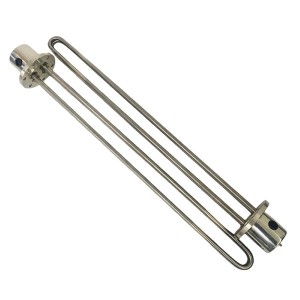
This deposited film is what people mean by coking. It’s not rust, and it’s not simple sludge sitting loosely on the surface — it’s a baked-on layer that forms specifically because the heater element runs hotter than the surrounding fluid, concentrating degradation right where the heat is highest.
Why This Turns Into a Vicious Cycle
Here’s the part that makes coking worse than a cosmetic issue. Once a coking layer forms, it acts as thermal insulation between the heater element and the oil it’s supposed to be heating. Heat transfer efficiency drops, which means the heater has to work harder — running hotter internally — to deliver the same amount of heat into the tank.
But a hotter heater surface accelerates the same degradation process that caused the coking in the first place. More heat concentrated at the surface means faster local oil breakdown, which means more coking forms, which further insulates the element, which pushes surface temperature up again. Each stage feeds the next one, and left unchecked, this cycle accelerates rather than staying at some stable, minor level.
What This Looks Like Physically
- A thin, dark, sometimes glassy-looking coating on the heater sheath where it’s been immersed
- Coating that’s often thicker at points where the element runs hottest, rather than evenly distributed
- In advanced cases, a coating that’s flaked or cracked from repeated thermal cycling, sometimes shedding small particles into the tank
Since the heater is submerged, none of this is visible during normal operation. You only see it during a tank inspection or heater removal, which is exactly why indirect detection methods matter so much for catching this early.
Detecting Coking Without Pulling the Heater Out
You can’t watch the heater surface directly while it’s doing its job, but you can watch how it performs, and performance changes are the earliest reliable signal that something’s building up on that surface.
Watching Heating Time
Every EH oil tank heating system has a rough baseline — how long it typically takes to bring oil from a cold start up to normal operating temperature, under similar ambient conditions. This baseline is worth establishing and recording early, because it’s your reference point for everything that comes after.
As coking builds up and heat transfer efficiency drops, that heating time starts stretching out. The heater’s still running, still drawing its rated power, but less of that heat is actually making it into the oil efficiently, so the tank simply takes longer to reach target temperature than it used to. A gradual, sustained increase in heating time — not just one unusually cold morning, but a real trend over weeks or months — is one of the clearest indirect signs of coking developing.
Watching the Rate of Temperature Rise
Closely related, but worth tracking separately: the actual rate at which oil temperature climbs once the heater is energized, measured in degrees per unit time rather than total time to reach setpoint. This is a more sensitive measurement than total heating time alone, because it can reveal a slowing trend even before total heating time has drifted enough to be obviously noticeable.
A heater working against a clean surface should show a fairly consistent rate of temperature rise for a given oil volume and starting temperature. If that rate starts declining over successive heating cycles, even while total heating time still looks roughly normal because of how the control system manages setpoint, that’s often the earlier warning sign compared to heating time alone.
| Indicator | What a Healthy Trend Looks Like | What Coking Looks Like |
|---|---|---|
| Total heating time to reach setpoint | Stable, consistent with historical baseline for given ambient conditions | Gradually increasing over weeks or months |
| Rate of temperature rise (°C per minute) | Consistent across heating cycles | Slowly declining, sometimes before heating time shows an obvious change |
| Heater surface temperature (if measurable) | Stable relative to oil bulk temperature | Increasing gap between surface and bulk oil temperature |
Setting Up a Practical Tracking Method
None of this requires sophisticated instrumentation beyond what most plants already have available on a tank heating circuit. A simple log, kept consistently, is often enough to catch a meaningful trend before it becomes a real problem.
- Record start temperature, end temperature, and elapsed time for each heating cycle, or at minimum a representative sample of cycles across different seasons and ambient conditions.
- Normalize comparisons where possible — comparing a summer heating cycle against a winter one without accounting for ambient temperature difference can create a false impression of degradation that isn’t really there.
- Plot the trend over months rather than judging any single cycle in isolation, since day-to-day variation is normal and a real coking trend shows up as a sustained direction, not a one-off reading.
- If the heater circuit includes a surface or sheath temperature sensor, track that against bulk oil temperature — a widening gap between the two over time is a particularly direct indicator, since it’s measuring the actual insulating effect coking creates.
How Often Should This Heater Actually Be Inspected?
There isn’t a single universal number that fits every installation, since coking rate depends on oil condition, how often the heater cycles, and how well the broader EH oil quality is being maintained. That said, a reasonable general practice is a visual inspection during scheduled major outages — typically annual or, depending on plant scheduling, at whatever interval the broader EH oil system undergoes planned maintenance — combined with continuous indirect monitoring through the heating time and temperature rise trends described above, checked at least monthly rather than only during outages.
The logic here is straightforward: physical inspection can only happen when the system is down and the heater is accessible, which for most plants means once or twice a year at best. Indirect trend monitoring, by contrast, can happen continuously without any additional downtime, and it’s what actually gives you the lead time to plan a heater inspection or cleaning before coking reaches a severe stage.
- Monthly: review heating time and temperature rise rate trends against established baseline, flagging any gradual drift for follow-up.
- At each planned outage or oil system maintenance window: physically inspect the heater surface if practical, checking for visible coking, discoloration, or surface buildup.
- Whenever oil sampling shows degrading fire-resistant fluid quality (rising acid number, for example): increase inspection frequency temporarily, since fluid degradation directly accelerates coking formation on the heater surface.
Why Catching This Early Actually Matters
A heater that’s allowed to coke progressively doesn’t just become less efficient — eventually, the vicious cycle described earlier can push the heater surface hot enough to cause more serious localized oil degradation right at the element, or in severe cases, contribute to premature heater element failure from sustained overheating that the control system doesn’t directly measure or protect against.
Catching the trend early, through the heating time and temperature rise indicators, gives maintenance teams the chance to schedule a proper cleaning or heater replacement during planned downtime, rather than discovering the problem only after a heater has failed or after oil quality has degraded further than it needed to.
If your plant operates an HY-GYY-2.4-380V or similar immersion heater in an EH oil tank, it’s worth setting up a simple heating time and temperature rise log now, even retroactively using recent operating data, so you have a real baseline to compare against going forward rather than starting from scratch after a problem’s already suspected.
A Few Related Practices Worth Considering
- Coordinate fire-resistant oil quality sampling with heater performance tracking, since the two are directly related — oil that’s degrading chemically accelerates the coking process on the heater surface.
- When a heater is removed for any reason, take the opportunity to inspect and, if needed, clean the sheath surface even if coking wasn’t the reason for removal in the first place.
- Keep spare heaters on hand appropriate to your plant’s typical replacement cycle, so a heater found to be significantly coked during an outage inspection can be swapped rather than requiring an extended cleaning process that delays returning the system to service.
Final Thoughts
The HY-GYY-2.4-380V electric heater does reliable work in an EH oil tank for a long time, but coking is a slow, self-accelerating process that works against it quietly, without any visible sign during normal operation. Watching heating time and the rate of temperature rise gives you an indirect but genuinely useful window into what’s happening on that submerged surface, often catching the trend well before it becomes severe.
Pairing that ongoing trend monitoring with periodic physical inspection during planned outages is a reasonable, practical approach for most plants — enough to catch coking early without requiring constant heater removal just to check on something that a simple performance log can usually tell you first.
Post time: Aug-26-2026
-

Industrial filtration Lube oil system Lube filt...
-

4.5A25 Hydrogen system brass safety release valve
-

Turbine Rotation Speed Impactor Monitor HZQW-03A
-

Surface cover epoxy air-dry varnish 1504
-

Pressure oil-return filter HQ25.600.15Z
-

DF6101 Steam turbine magnetic rotation speed se...
-

DWQZ series proximitor Axial displacement Eddy ...
-

Hydraulic filter element LH0160D020BN3HC
-

Stator Cooling Water Pump YCZ50-250C
-

Compressed Air Filter Element LX-FF14020044XR
-

Fire-resistant oil filter DP401EA01V/-F
-

GJCF-15 APH Gap Control system Signal Transmitter