

Thermal tightening depends on a number. The bolt needs to elongate by a specific amount, within a specific time, or the joint doesn’t come together with the preload it’s supposed to have. When that elongation falls short and the heating rod‘s insulation resistance still checks out fine, the problem isn’t electrical safety — it’s heating performance, and that’s a narrower question with a handful of real answers.
What Goes Into the Bolt Hole
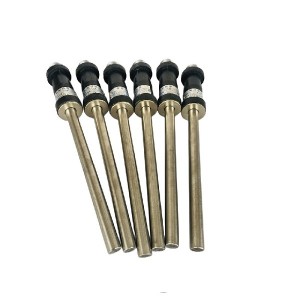
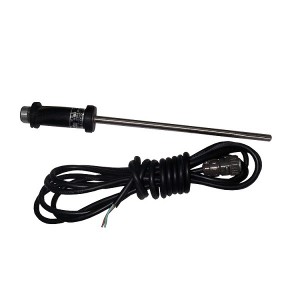
The ZJ-20-T6 is an electric heating rod built for thermal tightening and loosening of intermediate-pressure casing bolts on steam turbines, run through a DC heating control cabinet. Inside, the heating element is 0Cr27Al7Mo2 alloy wire, chosen for its high resistance and its ability to handle temperatures up to 400°C without breaking down. That wire sits inside a seamless sheath made of 1Cr18Ni9Ti heat-resistant stainless steel — sealed, straight, built to survive repeated insertion into tight bolt holes without damage.
Surface power density runs 6 to 8 W/cm². That range is what keeps heating even along the rod’s length rather than concentrated in hot spots, which matters directly for how uniformly the bolt actually expands.
Why Bolt Tightening Needs Heat in the First Place
Thermal tightening works by heating a bolt so it expands, then tightening the nut while the bolt is still hot and elongated. As the bolt cools afterward, it wants to contract, but the tightened nut prevents full contraction — that resistance to contracting is what generates the clamping preload. Get the elongation wrong, low or high, and the preload comes out wrong too. This is precision work disguised as a heating task.
Insulation Fine, Output Weak — A Specific Kind of Problem
Insulation resistance testing checks whether the heating element is electrically isolated from the sheath, confirming there’s no path for current to leak where it shouldn’t. A normal reading there rules out a certain category of failure — moisture ingress, insulation breakdown, that sort of thing. It says nothing about whether the rod is actually converting electrical input into heat efficiently, or whether that heat is actually making it into the bolt. Those are separate questions, and a rod can pass insulation testing completely while still underperforming badly on elongation.
Three Places Heat Can Go Missing
Long-term exposure to high operating temperature causes gradual oxidation in the alloy wire itself. Oxidation changes the wire’s cross-section and its surface characteristics over repeated heating cycles, and this tends to increase the wire’s electrical resistance somewhat compared to a new, unused rod. Higher resistance at the same applied voltage means less current, and less current means less power delivered — the rod produces less heat than it’s rated for, even though it still works.
An excessive gap between the rod and the bolt hole wall reduces how efficiently heat actually transfers from the rod into the bolt. Heat has to cross that gap, and air is a poor conductor compared to direct or near-direct contact. If the rod diameter doesn’t fill the hole closely enough — from wear on the rod, from a hole that’s slightly oversized for the specific rod in use, or from a mismatch introduced by using a rod meant for a different bolt configuration — a meaningful portion of the heat generated never actually reaches the bolt material where it needs to go.
Output voltage from the control cabinet not reaching its set value is the third possibility, and it points away from the rod entirely. If the cabinet’s actual delivered voltage sits below what it’s supposed to provide — from a cabinet fault, a loose connection somewhere in the supply circuit, or voltage drop across long or undersized cabling — the rod receives less power regardless of its own condition, and heating falls short even with a rod in perfect shape.
A Fast Check That Narrows Things Down Immediately
Measuring the rod’s cold resistance and comparing it directly against the nameplate value is a quick, genuinely useful first step, and it splits the three possibilities cleanly into two groups.
If cold resistance matches the nameplate value closely, the heating element itself is in good condition — no meaningful oxidation-driven resistance increase has occurred. That shifts suspicion away from the rod’s internal wire and toward the other two explanations: either the gap between rod and bolt hole, or the cabinet’s actual output voltage.
If cold resistance measures noticeably higher than the nameplate value, oxidation-related wire degradation becomes the leading explanation on its own. Resistance doesn’t drift upward for no reason, and a clear deviation from the original rated value is a fairly direct fingerprint of this specific failure mode.
Separating the Remaining Two
Where cold resistance checks out fine, the next step is confirming what voltage the rod is actually receiving during operation, measured as close to the rod’s own terminals as practical rather than relying solely on the cabinet’s own display. If the measured voltage at the rod matches the cabinet’s set point, the cabinet is delivering what it should, and the gap between rod and bolt hole becomes the more likely remaining cause.
If the measured voltage at the rod comes in below the cabinet’s set point, that points toward the cabinet or the supply circuit between the cabinet and the rod — worth checking cable condition, connection tightness, and the cabinet’s own internal output regulation before assuming the rod or the fit-up is at fault.
Checking the physical fit between rod and bolt hole is a fairly direct visual and measurement task where practical — comparing actual rod diameter against the bolt hole’s actual bore diameter, rather than assuming they match because they’re supposed to. A gap larger than the manufacturer’s specification for that particular bolt and rod combination confirms this as at least a contributing factor, independent of anything happening electrically.
Why All Three Deserve a Look Before Assuming One
It’s tempting to assume the rod itself is worn out anytime heating underperforms, since it’s the component doing the actual heating and the one most exposed to repeated thermal cycling. But a control cabinet delivering less voltage than intended, or a hole-to-rod fit that’s slightly too loose, produce exactly the same downstream symptom — insufficient bolt elongation for the time allotted — without the rod being at fault at all. Replacing a perfectly good rod because heating underperformed, when the real issue was a loose terminal connection in the supply cable, fixes nothing and wastes a serviceable part.
Field Practices Worth Building In
Recording cold resistance measurements for each rod against its nameplate value as part of routine pre-use checks, not just when a problem has already occurred, builds a simple record that makes future troubleshooting faster and catches oxidation-related degradation while it’s still gradual rather than after a bolt has already come up short on elongation. Verifying actual delivered voltage at the rod terminals periodically, rather than trusting the cabinet’s set-point display exclusively, catches cabinet or cable issues before they show up as a heating complaint in the middle of an outage. Confirming bolt hole dimensions against the specific rod being used, especially when rods or bolts are shared across multiple units or configurations, avoids a fit-up mismatch that has nothing to do with either component being faulty on its own.
Details Worth Confirming for Replacement Rods
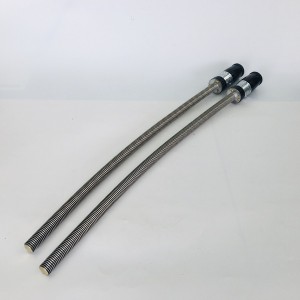
Confirm the nameplate cold resistance value for the specific rod length and rating being ordered, since this varies by rod size and isn’t a single fixed number across the whole product line. Confirm the rated surface power density and expected service life under the actual bolt tightening cycle frequency in use, since more frequent thermal cycling accelerates the oxidation process described above. Confirm compatibility between rod diameter and the actual bolt hole dimensions for the specific application, rather than assuming a rod that worked on one turbine unit will fit identically on another without checking.
Getting to the Answer Without Guesswork
A heating rod that passes insulation testing but still underperforms on bolt elongation isn’t a mystery with one obvious answer. It’s a short chain of checks — cold resistance against the nameplate first, then measured voltage at the rod, then the physical fit between rod and bolt hole — and each step in that chain either confirms or clears one of the three explanations before moving to the next. Most of the time, the answer shows up before the third check is even needed.
| Vibration Sensor ST-A3-B3 | thermocouple WREK2-330 | Protection table TM531-A00-B00-C02-D00-E00-F01-G00-I0-M1 |
| Eddy Current Sensor PR6423/001-141 | Thermal resistor element WZP2-001QT | UPS SURT10000UXICH |
| LVDT Sensor TD-200-3 | PILZ SAFETY RELAY PNOZ X7P C 230-240VAC 2n/o | 240v pressure switch RC861CZ090ZYM |
| intelligence Hand Operator NPDF-Q1113 | range of lvdt TDZ-1E-31 | capacitor for brushless exciter CAPACITOR FOR BRUSHLESS EXCITERJL 78 |
| Eddy Current Sensor PR6422/102-001 | Processor Module TMS5100-ST | DC voltage transducer WBV334U01 |
| Speed probe HRY1-A200-B02-C01-D05-E180 | proximity sensor rpm measurement TM301-A02-B01-C00-D00-E00-F00-G00 | BFP Rotation Speed Probe CS-3-G-150-05-01 |
| automatic temperature control system WSS-481 PT100 L=800MM 0-300℃ | AC current transducer, accuracy level 0.2; Output 4-20mA; 220V; 50HZ; Input O~120V DBS/Q-121 | speed sensor CS-1-G-065-05-01 |
| Electric heater 6KW | rpm measurement sensor SZC-04 | One phase transformer ZDG-1.5 |
| Probe (Sensor) CWY-DO-813506 | LVDT B152.33.01.01 (2) | Eddy Current Signal Converter CON041/915-060 |
| PARKER LUCIFER 322H35 | Magnetic Resistance Speed Sensor SZCB-01-A1-B1-C3 | Module Vibration HY-5V |
Post time: Sep-15-2026
-

LVDT Position Sensor HL-6-150-15
-

RTD thermocouple temperature sensor probe WZP2-231
-

Stainless Steel Bellows Globe Valve WJ40F-1.6P
-

Online Hydrogen Leak Detector KQL1500
-

CQJ type accumulator Gas charging tool
-

Regeneration device anion filter PA810-002D
-

LVDT sensor 1000TD
-

Accumulator Rubber Bladder NXQ-A-25/31.5
-

Generator RTV epoxy adhesive J0792
-

Filter element HDX-160×20Q2
-

EH oil regeneration filter ZX-80
-

Sealing Oil Differential Pressure Valve KC50P-97