

When you’re picking a solenoid valve for an EH oil system, the decision is almost never just about the valve on its own. It’s about how that valve’s internal geometry holds up inside oil that’s never truly clean, under thousands of open-close cycles over its life, and under pressure conditions where even a small leak can quietly mess with a control signal before anyone notices. The SV13-16-C-0-00 is a screw-in cartridge solenoid valve built on a cone valve structure, and there’s a question that comes up a lot during commissioning and troubleshooting: does a cone-and-seat design leak more than a spool valve when the oil has fine particles in it? And can a hardened core and seat actually stand up to that?
How It’s Built and How It Works
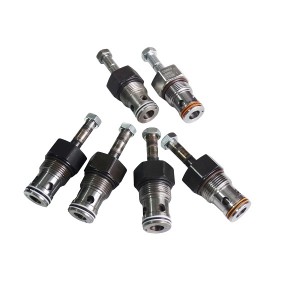
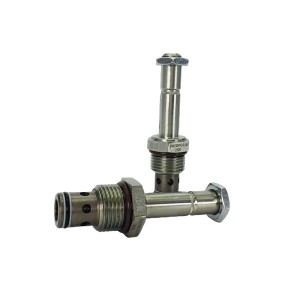
A cartridge valve like this one gets screwed straight into a cavity machined into a manifold block — that’s what “screw-in” means here — instead of being mounted with pipe fittings. Inside, the solenoid coil pushes a poppet-style core against a matching conical seat. The seal happens along a thin circular line where the cone meets the seat. That’s different from a spool valve, which seals along a longer cylindrical clearance fit.
This line-contact idea is exactly why cone valves get chosen when tight shutoff really matters. Since the contact band is so narrow, the sealing pressure at that line is quite high for a given closing force, and that’s what gives a new, well-kept valve its low leakage. But there’s a catch. That same narrow line has almost no room for anything sitting between the two surfaces. A spool valve, with its longer land and tighter diametral fit, doesn’t necessarily leak just because one particle passes through — a cone valve can.
Where It Sits in the System
In most EH systems, this kind of cartridge valve lives in a manifold block near the actuator or servo stage that controls the steam admission valves — governor valves, intercept valves, the hydraulic cylinders driving them. Its job is usually to isolate, dump, or redirect the high-pressure fluid (often a phosphate ester fluid) when a control or protection signal calls for it. Because these manifolds sit right next to actuators that need to react in a fraction of a second during a trip or load rejection, holding a seal statically matters just as much as switching fast.
What Makes This Valve Type Tick
The things worth focusing on here are the cone-seat sealing geometry, the hardened surfaces on the core and seat, and the compact cartridge design that lets it drop straight into the manifold without extra piping. Fewer external joints means fewer places where oil can leak out to atmosphere — but it doesn’t change anything about what happens on the inside if the oil is dirty.
Manufacturers usually give a recommended fluid cleanliness level for valves like this, along with hardness figures for the core and seat. If that data has actually been provided for a specific unit, it’s worth checking against the real filtration setup of the EH system instead of just assuming it matches.
The Problem Engineers Actually Run Into
In the field, internal leakage on a solenoid valve — cone or spool, doesn’t matter — usually creeps up slowly instead of failing all at once. Operators notice it as a slow pressure drop on a line that’s supposed to be sealed off, or as a small flow reading that shouldn’t be there at all when the valve is closed. So is a cone valve really worse off here than a spool valve? It helps to split that into two separate questions: is it geometrically more sensitive, and does the material actually hold up.
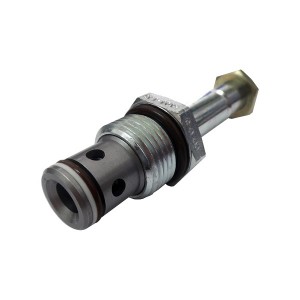
Geometrically, yes, it’s more sensitive. That narrow sealing line just doesn’t tolerate embedded particles the way a spool’s longer clearance path does. One hard particle sitting on the seat, or pressed into the softer surface, can hold the cone open by a few microns all the way around. That’s enough to create a steady leak. A spool valve with dirt in its clearance is more likely to show stiction or increased friction well before it shows a leak that size, because the leak path there is spread out rather than concentrated on one thin band.
Whether that theoretical weakness actually shows up as more leakage in real service comes down to surface hardness and what size of particles are actually floating around in the oil.
When Leakage Shows Up, What’s Really Going On
When a maintenance crew finds unexpected internal leakage on a valve like this, there are usually a few things it could be, and jumping straight to “it’s contamination” without checking the rest is a mistake people make more often than they should.
Particles sitting on the seat line. Fine hard particles — silica, pump wear debris, degraded seal fragments — land on the cone-seat interface during a closed period and stop full metal-to-metal contact. This tends to line up with something like a recent filter change, a filter bypass event, or a known source of contamination upstream.
Wear from repeated cycling. Even with no particle involved at all, the seat line can pick up micro-scoring after thousands of cycles, especially if the closing force is on the low side for the job or the fluid’s lubricity has dropped off. This kind of leak tends to build slowly over a long stretch rather than show up out of nowhere.
Fluid breaking down and affecting closing force. Phosphate ester fluid that’s picked up moisture or built up acidic breakdown products can, in some designs, affect actuation indirectly — through varnish or sludge on moving parts, for instance. It’s a less direct path to the same symptom, but it shouldn’t be ruled out if the other checks come up empty.
Telling Them Apart
None of these three can be confirmed just by measuring a leak rate. This is really where judgment matters more than any single number on a report.
If routine oil sampling shows particle counts climbing and that lines up with when the leak started, contamination is the more likely story. If cleanliness numbers have stayed within spec the whole time and the leak still showed up, wear or fluid degradation becomes more likely.
Cycle count history helps too. A valve that’s racked up an unusually high number of switching operations for its typical interval, and shows a leak that’s been getting worse gradually, points toward mechanical wear on the seat line. A valve with a low cycle count that suddenly starts leaking right after a known contamination event — a failed filter element, a reservoir top-up from a questionable source, some maintenance work that let debris in — points the other way, toward embedded particles.
Actually pulling the core and seat and looking at them under magnification is what really settles it. Embedded particle damage tends to show up as a localized dent or a small break in the sealing line. Wear damage looks more like a dull, even band running all the way around. Checking total acid number and moisture content in the fluid helps confirm or rule out the degradation path, though on its own it can’t prove there’s mechanical damage on the seat.
Do the Hardened Surfaces Actually Do Anything
Hardening the core and seat surfaces is meant exactly for this — resisting scratches and dents from hard particles in the oil. A harder surface raises the bar for how hard and how big a particle needs to be before it causes actual deformation at the sealing line, and it slows down how fast repeated contact turns into visible scoring. That doesn’t make the valve immune to contamination-related leakage. It just pushes the threshold higher, not away entirely.
If the EH oil in the actual system is running outside its specified cleanliness class, or filtration has slipped, even a properly hardened cone and seat will pick up damage eventually — just slower than an unhardened pair would. This is one of those spots where the fluid filtration spec and the valve spec really need to be looked at together, not as two separate line items on a purchase order. A cone valve’s tolerance for dirt in the oil is only as good as the filtration actually delivering clean oil in the first place.
Checking It in the Field and Keeping It Maintained
For a valve suspected of leaking internally, a reasonable inspection sequence starts with comparing the actual closed-position leak rate against what the manufacturer allows, then looking at recent oil cleanliness trends, then checking the cycle count against expected service life if that data is being logged. If the valve gets pulled apart for a physical look, the seat and core should be inspected under decent magnification before anyone cleans them — cleaning can wipe out the evidence of what actually caused the damage.
Routine maintenance on cartridge solenoid valves in EH service should include checking that upstream filtration is actually hitting its rated micron level, since that has a direct effect on seat life no matter what valve design is used. Coil resistance and response time checks are standard too, but those tell you about electrical and actuation health, not about seat sealing condition — they shouldn’t be used alone to decide whether there’s internal leakage.
What to Check Before Buying
If you’re specifying a screw-in cartridge solenoid valve like the SV13-16-C-0-00 for EH oil service, it’s worth confirming a few things directly with the manufacturer instead of assuming they’ll match: rated operating pressure and allowable leakage at that pressure, the fluid cleanliness class the valve is designed around, hardness spec and material of the core and seat, compatibility with the actual EH fluid in use (phosphate ester fluids especially), coil voltage and duty rating, and cavity dimensions so it actually fits the existing manifold.
It’s also worth asking the manufacturer for a recommended cycle life or service interval if they have one, and getting clarity on whether the cartridge is meant to be repaired or just swapped out at end of life. Those details matter more to total cost of ownership than the sticker price, especially for plants running continuous duty where an unplanned valve replacement means scheduling a shutdown window around the turbine’s operating status.
Wrapping Up
A cone valve, because of its line-contact sealing design, really is more sensitive to particle contamination than a spool valve’s spread-out clearance seal — that part isn’t really up for debate. What decides whether that sensitivity turns into an actual problem in a real EH system comes down to how fluid cleanliness, surface hardness, and duty cycle interact. Hardening the surfaces genuinely helps resist scratching and denting, but it manages the risk rather than getting rid of it entirely. For anyone specifying or troubleshooting a screw-in solenoid valve like the SV13-16-C-0-00, the filtration system and the valve really should be looked at as one working pair. And when leakage does show up, it’s worth pulling together cleanliness trends, cycle history, and a physical look at the seat rather than trusting any single number to explain what’s actually happening at the seal.
Post time: Sep-07-2026
-

Generator stator RTV epoxy adhesive J0708
-

Generator room temperature curing adhesive HDJ-16
-

Accumulator air inlet valve QXF-5
-

YAV-II accumulator Rubber bladder gas charging ...
-

High Temperature steam turbine cylinder sealing...
-

Heat-resistance FFKM Rubber sealing O-ring
-

Insulation Alkali-Free Fiberglass tape ET60
-

EH oil main pump discharge filter DP1A601EA01V/-F
-

CWY-DO Steam Turbine Eddy Current Sensor
-

Oil filter coarse filter DR913EA10V/-W
-

Gear Oil Pump GPA2-16-E-20-R6.3
-

Epoxy-ester insulating varnish H31-3