

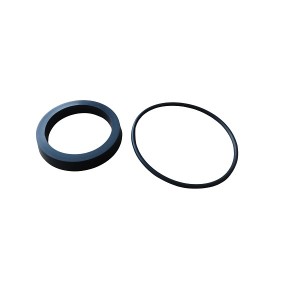
A dome valve seals by inflating a ring, not by clamping metal on metal. The P17458C-01 is that ring — silicone rubber, built into the dome valve, expanding under air pressure to press against the dome and shut off dust flow. Simple concept. But when dust starts leaking after the valve closes, and nothing looks wrong on the outside, the diagnosis gets harder than it sounds.
How the Seal Works
Air pressure inflates the ring. The ring expands outward and presses against the valve dome. That contact is what stops dust from passing through once the valve is shut. No inflation, no seal — the ring sits loose and the valve is effectively open, regardless of the dome’s mechanical position.
Full sealing needs a real pressure difference between the inside of the ring and the outside environment. Too little pressure, the ring does not expand fully. It touches the dome in places, not everywhere. Gaps remain, even if they are small.
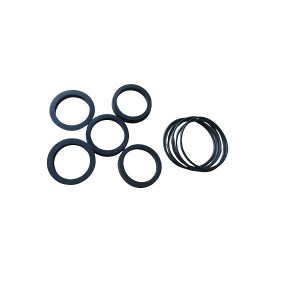
Where This Sits in the System
Pneumatic ash conveying systems move dust and ash through pipework using compressed air. Dome valves control where material enters or exits along that path. The sealing ring is what makes the valve airtight when closed, keeping dust contained and keeping conveying air pressure where it needs to be. A leaking dome valve does not just let dust escape locally — it can affect conveying pressure and flow balance elsewhere in the system too.
The Complaint: Dust Leaking, No Visible Damage
This is a common field report. The valve closes. Dust still gets through. Someone checks the ring by eye. No cuts, no obvious wear, nothing torn. The seal looks fine and still leaks.
Three explanations come up most often. Aging rubber that has lost elasticity. Inflation pressure that is not reaching the level it needs to. Or hard particles pressed into the sealing surface during inflation, creating tiny leak paths that are not visible without close inspection.
Aging and Loss of Elasticity
Silicone rubber degrades with time, heat, and repeated flexing. An aged ring can still look intact but respond more slowly, or not fully return to shape. It may inflate and appear to seat against the dome, but with less actual contact pressure than a newer ring would produce. The leak from this cause tends to be steady. It shows up consistently, cycle after cycle, and does not disappear on its own.
Insufficient Inflation Pressure
This is a supply-side problem, not a ring problem. If the air pressure feeding the ring is too low — from a regulator drifting out of calibration, a partially blocked supply line, or a compressor issue elsewhere in the plant — the ring simply never reaches full expansion. The ring itself could be in good condition and still fail to seal, because it was never given enough pressure to do its job.
This cause is usually the easiest to check. A pressure gauge on the inflation line, read during actual valve closure, either confirms adequate pressure or does not. If the reading is consistently below the manufacturer’s specified value, this is very likely the answer, or at least part of it.
Particles Pressed Into the Seal
This is the harder one. During inflation, the ring presses outward against the dome. If a hard particle sits at that exact contact line when inflation happens, the ring can press down onto the particle rather than around it. That creates a tiny channel right at the point of contact — too small to see without close inspection, but enough for dust to pass through under pressure.
What makes this cause difficult is timing. The particle may only be there during some inflation cycles. On deflation, the ring relaxes, and the particle can shift or fall away. The next cycle inflates cleanly, no leak. Then a new particle lands in a slightly different spot, and the leak returns. From the outside, this looks like an intermittent fault — leaking sometimes, sealing fine other times, with no obvious pattern.
Telling the Three Apart
A steady, repeatable leak on every cycle points away from particle embedding and toward aging or pressure supply. Particle-related leaks tend to be inconsistent by nature, since the particle position changes between cycles.
Checking inflation pressure directly rules the supply issue in or out. This should be done first, since it is fast and it removes one possibility with a single gauge reading.
If pressure is confirmed adequate and the leak still happens on every cycle, the ring itself becomes the suspect. At that point, checking the ring’s age against its expected service life, and its physical condition under closer inspection — not just a quick visual check, but feeling for stiffness or checking for surface glazing — helps confirm aging.
If the leak comes and goes with no clear pattern, and pressure is confirmed fine, particle embedding becomes the more likely explanation, even without seeing a particle directly.
Reproducing an Intermittent Leak
This is the harder part of the question, and there is no perfect method. But a few field approaches can improve the odds of catching it.
Running repeated open-close cycles in a controlled test, rather than waiting for the fault to show up during normal operation, increases the number of chances for a trapped particle to either cause a leak or get dislodged. Watching for a leak across ten or twenty cycles gives more information than watching for one.
Checking for dust or air leakage immediately after each individual inflation, rather than relying on a general system-level leak alarm, helps catch a leak that only lasts through one cycle before clearing itself.
Introducing a known volume of representative dust into the sealing area under controlled conditions — where practical, and with appropriate caution — can sometimes reproduce the fault more reliably than waiting for it to happen naturally, since it deliberately increases the chance of a particle landing at the seal line during inflation.
Inspecting the ring surface immediately after a leak event, before the next inflation cycle disturbs it, gives the best chance of actually finding the particle or the mark it left behind. Waiting until a scheduled shutdown days later often means the evidence is gone.
None of these methods guarantees catching the fault on the first attempt. Intermittent problems by definition do not show up on command. Repetition and quick inspection right after a leak event are the most practical tools available in the field.
Maintenance Considerations
Tracking ring age against the manufacturer’s expected service life helps catch aging-related leaks before they become a persistent problem rather than an occasional one. Regular verification of inflation pressure, not just at commissioning but as part of routine checks, catches supply drift before it causes a leak that gets blamed on the ring itself. Where dust content includes hard or abrasive particles, more frequent visual inspection of the ring surface, even without an active complaint, can catch early embedding damage before it becomes a recurring fault.

What to Confirm Before Ordering
For a replacement sealing ring like the P17458C-01, confirm the rated inflation pressure range and how it matches the actual supply pressure available at the valve. Confirm the expected service life or cycle count from the manufacturer, since this varies with material formulation and operating temperature. Confirm compatibility with the actual dust or ash composition being conveyed, particularly if the material is known to be abrasive or contains hard particulate. Where this information is not specified for a given batch or supplier, it should not be assumed to match a previous ring that performed well.
Closing Thought
A dust leak with no visible damage is not really a mystery — it just has more than one plausible cause, and the intermittent version adds a timing problem on top of that. Pressure checks are quick and should come first. Ring condition takes a closer look. Particle embedding is the one that hides best, and catching it usually means testing under repeated cycles rather than a single inspection after the fact.
Post time: Sep-10-2026
-

Electrical Insulation Alkali-free FiberglassTap...
-

High Energy Igniter Spark Rod XDZ-F-2990
-

Generator Surface flat sealant 750-2
-

Solvent-free RTV Epoxy adhesive 53841YR
-

Lubricating oil filter element 21FC5128-160X600/25
-

DFSS type steam turbine cylinder sealing grease
-

Recycle pump working filter DP1A401EA03V/-W
-

KEY PULSES (KEY PHASOR) Rotation Speed Sensor D...
-

Armored Thermocouple WREK2-294
-

SL-1250 Generator stator cooling water filter e...
-

Single Channel Speed Monitor D521.02
-

generator stator cooling water filter element K...