

The inlet guide vanes on a gas turbine are constantly moving. Every time load changes, every startup, every control system adjustment — the IGV actuator responds. That’s a lot of hydraulic activity, and all that oil flowing back and forth through the actuator circuit needs to stay clean. If it doesn’t, the precision components inside the actuator start wearing down, response accuracy drifts, and eventually you’re looking at actuator repairs that could have been avoided.
The C14633-001V is the filter element that sits in the IGV hydraulic actuator circuit and handles that contamination control job. It’s also used in bypass system actuator circuits on gas turbines, where the operating conditions are similarly demanding. This article gets into what the filter is built from, what it’s actually dealing with in service, and — probably the more useful part for anyone maintaining these machines — why gas turbine actuator filter duty is genuinely harder on filter elements than most steam turbine applications, and what that means for how you manage replacements.
What’s at Stake if the Actuator Filter Isn’t Doing Its Job
Gas turbine hydraulic actuators for inlet guide vanes and bypass systems contain tightly machined internal parts — servo valves, control spools, pistons — with clearances that are very small. Solid particles in the oil that are large enough to bridge those clearances cause abrasive wear every pass they make through the actuator. Smaller particles don’t do immediate damage, but colloidal contamination gradually builds up on valve seating surfaces and affects how accurately the actuator responds to control signals.
The C14633-001V sits in the supply line to the actuator and stops that contamination before it gets in. When it’s doing its job, the actuator responds accurately and the internal parts don’t wear faster than they should. When it’s not — whether because it’s loaded with debris and bypassing, or because the filter media has degraded and is no longer capturing particles effectively — the contamination gets through and the wear starts accumulating.
In a peaking gas turbine that starts and stops daily, the actuator is working hard every single day. The stakes for keeping clean oil in that circuit are higher than they might seem from looking at the filter itself, which is a relatively small and inexpensive component compared to the actuator assembly it’s protecting.
How the C14633-001V Is Built — and Why the Construction Details Matter
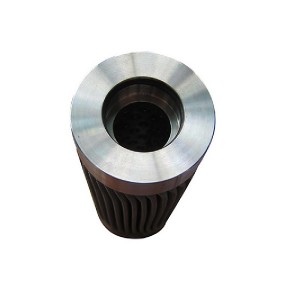
The filter element uses pleated glass fiber media over a stainless steel skeleton. Both of those choices are deliberate, and both matter for how the element performs in gas turbine service specifically.
Pleating the media dramatically increases the available filter surface area without increasing the physical size of the element. More surface area means lower fluid velocity through the media at any given flow rate — which improves particle capture and reduces the pressure drop across the element during normal operation. It also means the element can accumulate more contamination before differential pressure climbs to the point where it needs replacing. That’s practically useful in a gas turbine circuit where taking things offline for unplanned filter changes is disruptive.
The glass fiber media itself is a better choice for this application than paper or synthetic alternatives. Paper media can shed fibers when it’s subjected to repeated pressure cycling — and in a gas turbine actuator circuit, there’s a lot of pressure cycling. Glass fiber holds its structure better under those conditions, captures particles more consistently, and doesn’t contribute fiber contamination to the oil it’s cleaning.
The stainless steel skeleton is the structural backbone that holds the pleated media in shape. Under pressure surges, there’s force trying to collapse the pleats inward and compress the media. The skeleton resists that. Without it — or with a skeleton that’s not stiff enough for the pressure levels in this circuit — the pleats deform under repeated loading, the media fatigues, and filtration efficiency degrades well before the element reaches the end of its rated service life.
This combination of pleated glass fiber over stainless steel isn’t exotic engineering. But it’s the right combination for a high-cycling, high-pressure hydraulic actuator circuit, and cutting corners on either part of it tends to show up as problems in service.
The Pressure Cycling Issue — Gas Turbines vs. Steam Turbines
People who’ve worked with both gas turbine and steam turbine hydraulic systems often notice that actuator filters in gas turbine service seem to have shorter effective lives, or show structural wear that steam turbine filters don’t. There’s a real engineering reason for that difference, and it’s worth understanding.
Steam turbines, once they’re synchronized and running at load, tend to be fairly stable. The governing actuators are active during startup and shutdown, and during load ramps, but a baseload steam unit might go weeks between significant actuator movements. The filter element in that circuit sees sustained steady flow with relatively infrequent pressure transients. That’s not an easy environment, but it’s a predictable one.
Gas turbines are different in almost every relevant way. They start and stop more often — peaking and intermediate-duty units can cycle daily or even multiple times per day. Load changes are faster and more frequent. IGV position adjustments happen constantly as the control system optimizes combustion. Bypass system actuators respond to every change in operating condition. In a combined-cycle plant dispatching against grid demand, the actuator duty cycle can be extremely high.
Every time an actuator moves, it generates a pressure transient in the hydraulic circuit. The filter element experiences that as a mechanical stress — a momentary load trying to deform the pleated structure. One transient isn’t a problem. A thousand transients per week, week after week, is a fatigue loading condition. An element that would comfortably reach its rated service interval in a steam turbine application can develop structural fatigue much earlier in gas turbine service if it’s not built to handle that cyclic duty.
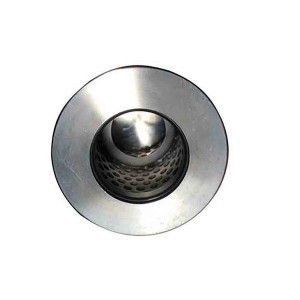
The stainless steel skeleton addresses this directly by constraining how much the pleats can flex under each pressure cycle. It doesn’t eliminate the stress, but it limits the strain on the media significantly — which is what extends fatigue life in a high-cycling application.
What Filter Fatigue Looks Like Before It Becomes Obvious
This is the part that catches maintenance teams off guard sometimes. Filter element fatigue in a high-cycling actuator circuit doesn’t usually show up as a sudden failure. It happens gradually, and the early signs are easy to miss or attribute to something else.
- Particle counts in the hydraulic oil start trending upward between filter changes, even though the differential pressure indicator still looks fine
- Actuator response accuracy starts to drift slightly — the IGV position doesn’t track control signals quite as crisply as it used to
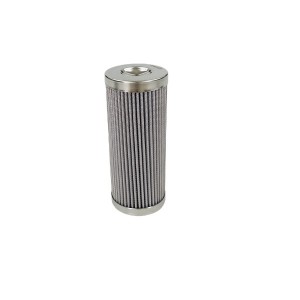
- The removed element shows pleat deformation or visible distortion of the support structure, even though it wasn’t at the differential pressure service limit
- Filtration efficiency has degraded enough that particles are getting through, but the element hasn’t blocked enough to trigger the bypass
The last point is the tricky one. Differential pressure tells you when the element is loaded enough to restrict flow. It doesn’t tell you whether the media is still capturing particles effectively. A fatigued element can have acceptable differential pressure while its actual filtration efficiency is well below spec. In a precision actuator circuit, that distinction matters.
Gas Turbine vs. Steam Turbine: How the Filter Requirements Compare
| Factor | Gas Turbine Actuator Filter | Steam Turbine Actuator Filter |
|---|---|---|
| Actuator cycling frequency | High — frequent load changes, daily start/stop cycles | Lower — more stable baseload operation typical |
| Pressure transient frequency | High — each actuator movement generates a transient | Moderate — mainly during startup and shutdown |
| Fatigue demand on filter media | Significant — structural support is critical | Lower — standard construction usually adequate |
| Skeleton material | Stainless steel required | Lower-grade support often acceptable |
| Replacement interval approach | Differential pressure plus oil particle count trending | Primarily differential pressure and time-based |
| Risk of media fatigue before DP limit | Real risk in high-cycling service | Less common under typical operating conditions |
How to Actually Monitor This Filter in Service
For gas turbine actuator circuits, differential pressure monitoring alone isn’t enough. It tells you one thing — whether the element is restricting flow. It doesn’t tell you whether the filter is still capturing particles effectively, which in a high-cycling application is the more important question after the element has been in service for a while.
Routine oil sampling with particle count analysis is the most reliable way to track actual filter performance. If particle counts in the IGV or bypass actuator circuit are trending upward between filter changes — especially in the size range the filter is rated to capture — that’s a clearer signal that the element needs attention than waiting for the differential pressure indicator to trip.
The interval between samples doesn’t have to be short. Quarterly sampling is often enough to catch a trend developing, and the cost of the analysis is trivial compared to what an actuator overhaul costs. Plants that do this consistently tend to catch filter performance issues early enough to plan replacements during scheduled maintenance windows rather than dealing with them reactively.
When you pull the old element, look at it before you throw it away. Pleat deformation, any kind of visible distortion in the stainless steel support structure, or media discoloration that’s uneven across the element surface are all worth noting. If the same pattern shows up at each replacement, it’s telling you something about how hard the element is working — and possibly that the replacement interval is too long for the actual duty the unit is running.
A Few Things to Get Right During Replacement
Replacing the C14633-001V is straightforward work, but there are a couple of points where it’s easy to create problems if the job is rushed.
Before opening the filter housing, isolate and depressurize the circuit. Gas turbine hydraulic actuator circuits run at significant pressure, and residual pressure can remain in the line even after the actuator has stopped moving. Confirm zero pressure before loosening the housing — don’t rely on the system being “off” as confirmation that the line is depressurized.
Drain the housing before pulling the element. The oil sitting in there has the highest particle concentration in the circuit — that’s what the filter has been collecting. Pulling the element without draining first sends that contaminated oil everywhere, and some of it will find its way back into the system. Drain into a clean container, look at what comes out, and note anything unusual before disposing of it.
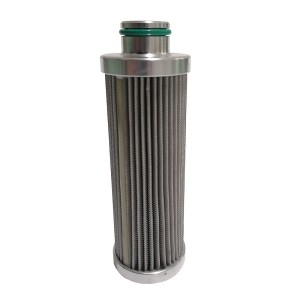
When the new C14633-001V goes in, make sure it’s fully seated and the end caps are properly engaged with the housing sealing surfaces. A filter element that’s slightly off-center can bypass oil around the end cap seal rather than through the media — which means the actuator circuit is running unfiltered from the moment you restart, even though the housing is closed and everything looks fine from the outside.
Sourcing Replacements: Why the Specification Details Matter
The C14633-001V has specific construction parameters — pleated glass fiber media, stainless steel skeleton, defined micron rating, particular end cap configuration and dimensional fit. All of those need to match to deliver the performance the actuator circuit requires in gas turbine service.
Substitute elements that fit the housing mechanically but use a different skeleton material, lower-grade media, or different pleat geometry may work fine in lower-duty applications but fall short under the pressure cycling conditions of IGV and bypass actuator service. The failure mode isn’t always obvious immediately — it tends to show up as gradually degrading oil cleanliness and eventually as actuator performance issues that take time to trace back to the filter.
If you’re evaluating replacement options for C14633-001V or trying to cross-reference an equivalent for your specific turbine model, a supplier with solid experience in gas turbine hydraulic system components can usually verify compatibility quickly. It’s a faster path than working through data sheets and hoping the dimensional and performance specs line up correctly.
The filter itself is a small part relative to everything downstream of it. Getting the right one in, replacing it before it degrades in ways differential pressure alone won’t catch, and keeping an eye on oil cleanliness trends — that’s the maintenance approach that keeps IGV and bypass actuators in good shape between major overhauls.
Post time: Jul-03-2026
-

HSN series three-screw pump
-

AST solenoid valve coil Z6206052
-

Stator coil surface HR anti-corona varnish 1244
-

EH oil-return filter DL006001
-

Filter element MZFP-32-118 mesh
-

Solvent-free RTV Epoxy adhesive 53841YR
-

Flow Control Servo Valve 072-1202-10
-

Steam Turbine Magnetic Rotation Speed Sensor SM...
-

Generator Cover Mannual Sealant Injector KH-32
-

Generator grey insulating varnish 1361
-

Globe valve SHV25
-

ZB2-BE101C handle selector push button Option s...