

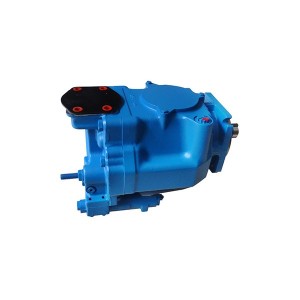
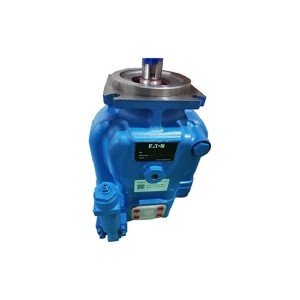
The PVH098R01AD30A250000001001AE010A is a pressure-compensated variable displacement piston pump used as the main oil pump in steam turbine EH oil systems. It converts motor shaft power into high-pressure fire-resistant oil supply for the turbine’s governing and protection circuits — and unlike fixed-displacement alternatives, it adjusts its own output to match what the system actually needs at any given moment.
Role in the EH Oil System
EH oil systems supply phosphate ester hydraulic fluid at high pressure — typically 14 MPa or above — to the steam control valves, main stop valves, and AST solenoid valve circuits of large steam turbines. The main oil pump is the origin point of that pressure. Everything downstream, from the servo valves to the actuator cylinders, depends on the pump maintaining stable supply pressure within a tight band regardless of how much flow the system is drawing at any instant.
The PVH098 series pump serves this role in many 300 MW and larger units across Chinese and international power plants. The full model designation — PVH098R01AD30A250000001001AE010A — encodes the specific configuration: displacement class (098 cubic centimetres per revolution at maximum stroke), rotation direction, shaft type, port configuration, pressure compensator setting, and other build details that affect how the pump integrates with a specific EH system design.
Downstream loads on the EH system are not constant. During normal turbine operation at steady load, the governing valves are held at fixed positions and oil demand is low — mostly internal leakage compensation. During load changes, valve position adjustments demand brief surges of flow. During a trip, all control valves go to their fail-safe positions simultaneously and flow demand spikes sharply. The variable piston pump handles all of these conditions without wasting energy.
How Pressure Compensation Works in Practice
A fixed-displacement pump delivers the same flow volume per shaft revolution regardless of system pressure. When system demand is low, the excess flow goes back to the tank through a relief valve — converting pump work into heat rather than useful hydraulic output. In an EH oil system running continuously for 8,000 hours per year, that energy loss is substantial.
The PVH098R01AD30A250000001001AE010A main oil pump uses a swash plate mechanism to vary the piston stroke — and therefore the displacement per revolution — in response to system pressure. When system pressure reaches the compensator set point, the swash plate angle reduces, decreasing piston stroke and limiting pump output to only what is needed to maintain that pressure. The pump continues rotating at motor speed but is effectively at near-zero displacement when the system is fully pressurised and flow demand is minimal.
This is the energy efficiency advantage that pressure-compensated variable piston pumps offer over gear or vane pumps in this application. The motor load tracks actual hydraulic power demand rather than running at full output continuously. Over a typical turbine operating cycle, the difference in motor energy consumption between a properly functioning variable piston pump and a fixed-displacement pump of equivalent capacity is significant.
The Shaft Seal: Where Quiet Failures Begin
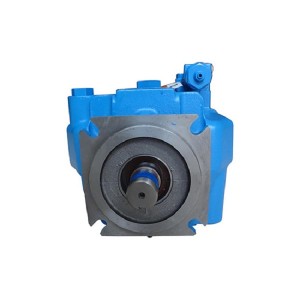
The drive shaft of the PVH098 pump exits the pump housing through a lip seal — commonly called a skeleton oil seal or shaft seal — at the motor-pump coupling end. This seal prevents the pressurised case drain oil inside the pump housing from escaping along the shaft, and it keeps the internal pump environment separated from the motor compartment.
Phosphate ester fluid is chemically aggressive toward certain elastomers. The shaft seal must be made from a material compatible with fire-resistant EH oil — typically fluorocarbon (FKM/Viton) — and it must maintain sealing contact against the rotating shaft over years of continuous operation. Shaft surface finish, shaft runout, and oil contamination level all affect how long the seal lasts.
When the shaft seal begins to fail, the consequence is not just an oil leak from the pump exterior. In a motor-driven pump where the shaft coupling passes through or adjacent to the motor housing, any oil that escapes past the seal can travel along the shaft and enter the motor. Phosphate ester fluid is electrically conductive and chemically reactive with copper winding insulation. Even small quantities reaching motor stator windings will begin degrading the insulation. The motor may continue operating for weeks or months before the insulation damage becomes severe enough to cause an electrical fault — but the damage accumulates throughout that period.
Finding Shaft Seal Failure Before the Oil Reaches the Motor
The challenge with early shaft seal degradation is that the leak volume is initially small enough to evaporate or be carried away before it accumulates visibly. Standard visual inspections during walk-downs may not catch it. Several less obvious detection methods are more reliable in the early stages.
Oil Level Trending
The EH oil tank level should be checked and logged at each watch handover — not just noted as “normal” but recorded as a specific value. A tank level that is dropping consistently at a rate that cannot be explained by known external drains, sampling losses, or recent filter changes is losing oil somewhere. Cross-reference the level trend with any recent maintenance activity; unexplained slow level decline over days or weeks points to an internal leak or a shaft seal that is passing oil.
Even a daily level check with a consistent reference point accumulates useful trend data within a week. The quantity of oil lost through an early-stage shaft seal failure may be only a few hundred millilitres per day — invisible as a puddle, but traceable as a level trend.
Visual Inspection at the Shaft Coupling
The area immediately around the pump shaft and coupling should be part of routine inspection rather than a check triggered by visible leakage. In early seal failure, oil often appears as a faint surface discolouration, a slight tackiness or colour change on the coupling guard interior, or a very thin film on the shaft itself near the seal exit point.
Using a clean white cloth or lint-free swab to wipe the shaft area near the seal confirms what the eye might miss. A trace of phosphate ester fluid on a white cloth — even a very faint stain — indicates oil is escaping the seal. Phosphate ester is clear to pale yellow; on a white cloth it shows as a faint transparent discolouration with a characteristic ester chemical odour.
UV Fluorescent Dye Check
Adding a small quantity of UV fluorescent dye compatible with phosphate ester fluid to the EH oil tank — dye specifically rated for fire-resistant hydraulic fluid — and then inspecting the pump shaft area with a UV lamp during a subsequent watch identifies seal weepage that is otherwise invisible. This method is more definitive than cloth-wiping because it amplifies very small traces of fluid to a clearly visible glow. It is particularly useful for confirming whether a suspected early-stage seal leak is real before committing to a seal replacement that requires taking the pump out of service.
Motor Insulation Resistance Monitoring
An EH oil pump motor whose shaft seal has been passing oil for any significant period will show a declining insulation resistance trend between the winding and the motor frame. Megohmmeter testing of the motor winding insulation at each scheduled maintenance interval — and recording the values rather than just noting pass/fail — provides the trend data that catches this. A motor whose insulation resistance is falling steadily across consecutive measurements needs investigation, not reassurance.
Diagnosing Why the Shaft Seal Has Failed
Replacing the seal without understanding why it failed leads to repeat failure. The root causes fall into a few identifiable categories, and distinguishing them affects what else needs to be corrected alongside the seal replacement.
| Failure Cause | Indicators at Inspection | Corrective Action Beyond Seal Replacement |
|---|---|---|
| Seal material incompatible with phosphate ester | Seal lip swollen, softened, or cracked; rubber material shows chemical attack; may have failed early in service life | Confirm replacement seal is FKM-rated for phosphate ester service. Do not use standard nitrile seals in EH oil applications. |
| Shaft surface wear or scoring under seal lip contact area | Visible groove or rough band on shaft at seal contact point; seal lip itself may be intact | Inspect and measure shaft at seal contact zone. If groove depth exceeds acceptable limits, shaft repair or sleeve fitting is required before new seal will seal reliably. |
| Excessive shaft runout from coupling misalignment | Uneven seal lip wear; seal scored on one side; coupling alignment check shows deviation | Re-align motor and pump coupling to within specification. Check pump and motor shaft bearings for wear that may contribute to runout. |
| Case drain back-pressure too high | Seal lip forced outward; case drain line partially blocked or too small in bore; seal failure occurs at shaft exit point under pressure | Check case drain line for restriction or kinking. Measure case drain back-pressure against pump specification. Case drain must flow freely to tank at near-zero back-pressure. |
| Oil contamination — high acid number or particulates | Seal surface degraded chemically; other seals and O-rings in the system also showing deterioration | Test EH oil acid number and water content. High acid number from phosphate ester hydrolysis attacks elastomers throughout the system. Oil conditioning or replacement may be required alongside seal work. |
| Seal aged beyond service life | Seal lip hardened and lost contact force; no chemical damage; no shaft damage; seal is simply end-of-life | Replace on a defined interval going forward. Seals on continuously running EH oil main pumps typically warrant replacement at each major turbine overhaul regardless of visible condition. |
Maintenance Priorities for the PVH098 Main Oil Pump
The PVH098R01AD30A250000001001AE010A operates continuously in most turbine plants — often 8,000 hours per year at rated speed, with only brief interruptions during planned outages. The maintenance tasks that most directly affect reliability are not complex, but they require consistent execution.
- EH oil cleanliness: The pump’s precision-clearance internal components — pistons, cylinder block, valve plate — are sensitive to particulate contamination. Maintain the system ISO cleanliness class within the specification for the installed servo valves and actuators. The pump and servo valves share the same contamination exposure.
- Case drain line inspection: Verify the case drain line is clear and the back-pressure at the pump drain port is within the manufacturer’s limit. A restricted drain line is one of the more common causes of shaft seal failure on axial piston pumps.
- Shaft seal replacement at overhaul: Even a seal that shows no visible leakage at inspection will have accumulated service hours on the lip contact zone. Replace on schedule rather than condition alone, and document the shaft surface condition at each replacement.
- Compensator function verification: Test that the pressure compensator is maintaining the correct set point and that the pump destroke response is functioning correctly. A compensator that is stuck or drifted will either over-pressurise the system or fail to maintain adequate pressure during high-demand events.
E-mail: sales@yoyik.com
Tel: +86-838-2226655
Whatsapp: +86-13618105229
Yoyik offers various types of power plants spare parts for steam turbines, generators, boilers as below:
hydraulic accumulator charging kit LNXQ-A-10/20 F Y
two-way solenoid valve PCV-03/0560
Mechanical seal ZU44-45
EH HP accumulator bladder A25/31.5-L-EH
Pump O-ring YCZ50-250C
oil pump replacement 70LY-34×2-1B
DIRECTIONAL CONTROL VALVE DBDS10GM10/2.5
ACUMULATOR NXQ1-10/10-L-Y
Submerged pump 100YW50-100-50-30
SOLENOID VALVE TURBINE DF20051
RCV servo valve PSSV-890-DF0056A
MOOG 730-4229B
VALVE Q641F-16C DN25
vacuum pump rear end cap P-1761
Bladder + Seal kit NXQA-10/20-L-EH
lube oil accumulator AB25/31.5-L-E
pilot operated solenoid valve 4WE6D62/EG220N9K4/V
Bladder + Seal kit NXQ-A-25/31.5-L-EH
Globe valve GR2-0-KB-G5/30X48
seal kit SF08-23-P-O-P-230AG
Post time: May-28-2026
-

BFP lube filter QF9732W25HPTC-DQ
-

CS-V hydraulic system filter Differential press...
-

DFSS type steam turbine cylinder sealing grease
-

High Pressure Welding Angle Globe Valve J64Y-64
-

Hydraulic Accumulator NXQ-A-6.3/31.5-L-Y
-

APH Gap Control System Gap Sensor Probe GJCT-15-E
-

CWY-DO Steam Turbine Eddy Current Sensor
-

Stator coil surface HR anti-corona varnish 1244
-

TD-2 Steam Turbine Heat Thermal Expansion Sensor
-

DET Series Displacement Sensors
-

Steam Turbine Rotation Speed Sensor CS-2
-

WTYY series Bimetal Thermometer Temperature Gauge