

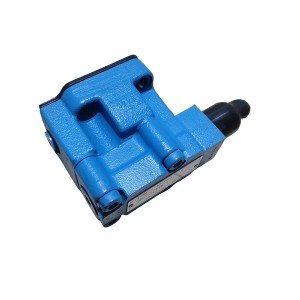
A relief valve has one job. Open when pressure is too high. Stay shut the rest of the time. The DBDS10G10/5 is a direct-acting relief valve with a poppet-style spool. It can act as a safety valve, protecting the system from over-pressure. It can also act as a back-pressure valve, holding pressure at a set point for the rest of the system. When it stops doing this correctly, pressure drops or spikes. In a turbine EH oil system, either one is a real problem.
Inside the Valve
A poppet sits against a seat. A spring holds it closed. Oil pressure pushes from the other side. Pressure rises past the spring’s set force, the poppet lifts, oil flows through. Pressure drops, the spring closes it again. No pilot stage. No intermediate valve. Spring and system pressure act directly on the poppet.
A damping orifice is usually built in as well. It smooths the poppet’s motion. Without it, the poppet can chatter — open and close rapidly, in short bursts, instead of moving cleanly.
Where It Sits
This valve typically installs on the pump discharge line, or somewhere else in the circuit that needs a hard pressure limit. As a safety valve, it protects piping, actuators, and seals from pressure spikes. As a back-pressure valve, it keeps a minimum pressure so servo valves and actuators downstream get what they were designed around.
The Field Complaint
System pressure will not build to rated value. Or it stays lower than it should, even with the pump running normally. Both point to the same thing at the valve itself — it is opening too early, staying slightly open when it should be shut, or leaking past the seat more than it should.
Particles as a Cause
Real and common. The poppet and seat form a metal-to-metal seal. A hard particle caught between them stops full closure. Even one small particle on the seat line leaves a gap. Oil bleeds through that gap continuously. Repeated particles passing through can also wear or scratch the surfaces. The leak stops being occasional and becomes permanent.
Contamination-related leaks tend to show up fairly suddenly. Often after a filter problem, a bypass event, or maintenance work that let debris in. They can also behave unpredictably — pressure recovers a little if a particle shifts, then drops again later.
Particles are not the only explanation, though. Two other causes look similar on the surface.
Spring Fatigue
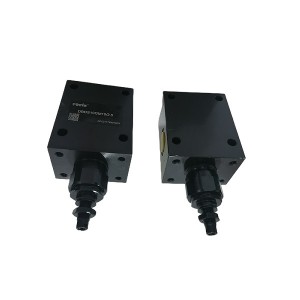
The spring sets the opening pressure. A weakened spring — from age, heat, or fatigue — opens the valve too early. Unlike particle contamination, this tends to be steady. Pressure runs consistently low, not erratic. A tired spring gives a predictable, repeatable shortfall.
Sealing Surface Damage
Separate from particle wear, the poppet or seat surface can degrade on its own. Corrosion. Long-term cycling wear. Occasionally a manufacturing flaw that only shows up after time in service. The leak looks similar to a contamination leak. It just does not trace back to any specific event, and it tends to develop slowly.
Clogged Damping Orifice
This one behaves differently. A clogged orifice does not usually cause low pressure by itself. It causes instability — chatter, sluggish response, pressure overshoot. If the poppet reacts too slowly to changing pressure, spikes and swings show up instead of a flat, low reading. Different symptom, different problem.
Sorting the Three Out
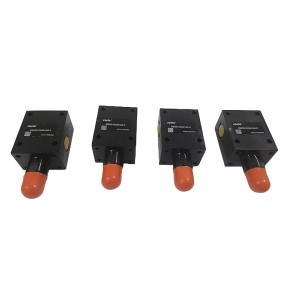
A pressure gauge alone will not tell you which of these is at fault. It just tells you something is wrong. A few more checks are needed.
Pressure trend over weeks or months. A slow, steady decline suggests spring fatigue or gradual surface wear. A sharp drop, especially one lining up with a known contamination event, suggests particles.
Stability of the reading. Steady but low points to spring weakening or a worn seat holding a small constant leak. A reading that jumps around, or audible chatter, points to the damping orifice — or possibly a particle shifting position under flow.
Oil sample history. Particle counts within spec the whole time make contamination less likely. That shifts attention toward spring or surface wear instead.
Physical inspection. This is the step that actually confirms things, though it means pulling the valve. Scoring or pitting on the poppet and seat confirms surface damage. Measuring spring free length against the original specification confirms or rules out fatigue. Flushing or inspecting the damping orifice confirms whether it is blocked.
None of these on their own gives a full answer. Trend data supports a theory. Oil samples rule contamination in or out. Physical inspection is usually the last step, taken once the earlier checks have narrowed things down.
Maintenance Notes
Oil cleanliness monitoring matters most here. The poppet-seat interface has almost no tolerance for particles once they reach the seal line. Regular pressure testing against the rated set point builds the trend data that makes future diagnosis faster. During outages, a visual check of the poppet, seat, and spring length can catch early wear before it turns into a real pressure problem.
Before Buying
Confirm the rated set pressure and its adjustment range. Confirm the fluid cleanliness class the valve is built to handle. Confirm poppet and seat materials and their compatibility with the actual EH fluid. Confirm the damping orifice response for the expected flow rate. If a manufacturer has not provided this for a specific unit, do not assume it. Ask directly — this valve is doing two jobs, over-pressure protection and steady back-pressure regulation, and both depend on these details being right.
In the Field
A relief valve that will not hold pressure rarely has one clean explanation. Particles are common. Spring fatigue and surface wear produce a similar-looking shortfall through a different path. A clogged orifice adds instability rather than a flat low reading. Telling them apart takes trend data, oil history, and usually a look inside the valve itself. A pressure gauge alone will not get you there.
Post time: Sep-09-2026
-

EH oil main pump PVH074R01AB10A250000002001AE010A
-

AXIAL DISPLACEMENT MONITOR HZW
-

Low resistance anti-corona tape
-

OF3-08-3RV-10 EH oil main tank circulating pump...
-

Lubricating oil filter element LY-48/25W
-

Hydraulic oil return filter element MF1802A03HVP01
-

Generator Oil-resistant Rubber Round Strip
-

Actuator Inlet Working Oil Filter DP301EA10V/-W
-

KEY PULSES (KEY PHASOR) Rotation Speed Sensor D...
-

DF6101 Steam turbine magnetic rotation speed se...
-

Dual color water level gauge Tempered glass acc...
-

LVDT Position Sensor HL-3-100-15